
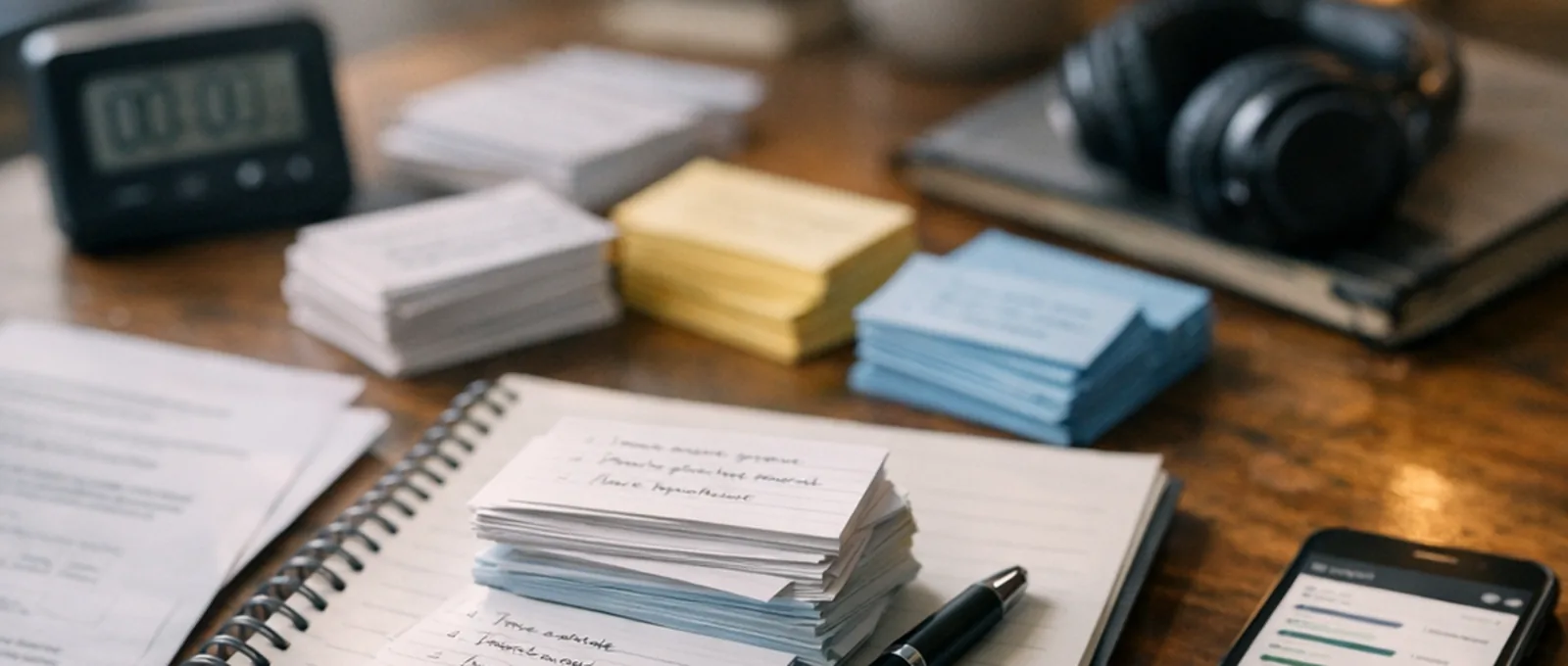
The 20-Minute Active Recall Question Bank: Turn Any Lecture into 30 Self-Test Questions (Fast)
Stop rereading. Start testing.
In 20 minutes, you can turn one lecture into ~30 active-recall questions you’ll actually use—sorted by difficulty, reviewed on a dead-simple schedule, and tracked in LogMyStudy so you know what’s sticking (and what’s… politely falling out of your brain).
Why this works (and why rereading doesn’t)
Rereading feels productive because it’s familiar. Your brain is basically going, “Ah yes, I recognize these words,” and then clocking out.
Active recall forces retrieval. Retrieval is the workout. Recognition is watching workout videos.
Active recall = forcing your brain to retrieve, not recognize.
A question bank beats “pretty notes” because it creates instant practice tests.
You only need one repeatable workflow—not a new study personality.
What counts as active recall (quick checklist)
You can answer without looking.
You can explain it in your own words.
You check your answer after you attempt it (notes/slides are the answer key, not training wheels).
Common traps to avoid
Copying definitions into flashcards (that’s often recognition, not recall).
Making questions that are too vague: “Explain chapter 4.” (Your brain: “No.”)
Creating 200 cards you’ll never review. (A question bank you don’t revisit is just fan fiction.)
Your 20-minute setup: from lecture → 30 questions
Goal: 30 questions, not perfect questions.
Time-box it: speed first, refine later during review.
Use the same templates every time to stay fast.
Minute 0–3: Grab your inputs (no rewriting notes)
Open: lecture slides + your notes + any assigned reading headings.
Skim for: learning objectives, bold terms, diagrams, “steps,” comparisons.
Pick 6–10 chunks (mini-topics) from the lecture.
Rule: you are not allowed to “make nicer notes” during this step. You are here to steal question ideas and leave.
Minute 3–12: Generate questions using 5 templates (plug-and-play)
Pick a chunk. Fire off 3–5 questions. Repeat. Quantity wins.
Definition → “What is X? What is it not?”
Process → “List the steps of X in order; what happens if step 2 fails?”
Compare/contrast → “How is A different from B? Give 2 differences.”
Cause/effect → “What causes X? What are 2 consequences?”
Example/application → “Given scenario Y, which concept applies and why?”
Minute 12–17: Add difficulty labels (so reviews don’t waste time)
Difficulty labels prevent you from spending 10 minutes “reviewing” things you already know.
Easy: direct recall (terms, simple facts).
Medium: explain/compare (short reasoning).
Hard: application (new scenario, multi-step, “why”).
Aim for a mix: ~10 easy / 12 medium / 8 hard.
Minute 17–20: Write answers the right way (short + checkable)
Keep answers to 1–4 lines whenever possible.
Include one key detail that proves understanding (not fluff).
If an answer needs a paragraph, split the question into 2–3 smaller questions.
Good answers are boring. They’re easy to check and hard to argue with.
Example: turning one lecture into questions (fast demo)
You can do this with literally anything: bio, history, psych, math, business, nursing—if it can be tested, it can be questioned.
Pick a real lecture topic and run the templates.
Go for variety: facts + reasoning + application.
Your goal is testable, not beautiful.
Sample set (mini) you can copy
Define X in your own words; give one non-example.
List the steps of X; where do people most commonly make mistakes?
Compare A vs B: 2 differences + 1 similarity.
If variable Z increases, what happens to outcome Y and why?
Given a short scenario, choose the correct concept and justify it in 2 sentences.
How to review the question bank (simple schedule that sticks)
Making questions is the setup. Reviewing them is where your brain actually keeps the file.
Keep it lightweight. You’re building a habit, not filming a montage.
Use short sessions: 5–15 minutes beats marathon cramming.
Prioritize misses, not volume.
The “1–3–7” review rhythm (minimal but effective)
Day 1: same day or next day (first retrieval).
Day 3: quick retest (strengthen).
Day 7: exam-style pass (durability).
How to run a 10-minute review session
Start with Hard + previous misses first.
Answer out loud or on blank paper (no peeking).
Mark each question: Got it / Kinda / Missed.
Only rewrite questions that were confusing—not all of them.
Organize it in LogMyStudy (so you don’t lose track)
The best question bank is the one you can find again in two days.
Create one entry per lecture or per topic chunk—whatever matches your class.
Store questions as a reusable bank; track what you missed.
Use tags to filter what to review when time is tight.
Suggested structure (takes 2 minutes)
Title: Course + Lecture # + topic.
Tags: unit, exam name, difficulty (Easy/Med/Hard), question type (Def/Process/Compare/App).
Fields/notes: paste questions, then add answers underneath or in a separate section.
After review: log score (e.g., 18/30) + list top 3 weak areas.
When you’re behind: the “minimum viable question bank”
When life is chaos, shrink the system. Don’t abandon it.
Make 12 questions: 4 easy, 5 medium, 3 hard.
Review them twice this week (Day 1 + Day 3).
Expand later only if the exam is still shaky.
Troubleshooting: when active recall feels hard (it’s supposed to)
If it feels harder than rereading, congratulations: you’re doing the part that works.
Struggle is the point—but confusion means the question needs tightening.
If you blank constantly, downgrade difficulty and build back up.
If you ace everything, add application questions.
Fixes for common problems
“My questions are too easy” → Add why and scenario-based prompts.
“I don’t know what to ask” → Use headings/objectives + the 5 templates only.
“I spend forever making cards” → Cap creation at 20 minutes; refine during reviews.
“I forget after a week” → Use 1–3–7 + prioritize misses.
FAQ
How many active recall questions should I make per lecture?
Aim for ~30 if you have time, but 12 is enough to start (4 easy, 5 medium, 3 hard). Consistency beats volume.
Is this the same as flashcards?
It can be, but it doesn’t have to be. Flashcards are one format; the key is that you attempt an answer before checking. A question bank can live in notes, a doc, or LogMyStudy.
What if my lecture is mostly math/problem-solving?
Make questions like: “Solve this type of problem,” “Choose the right method and explain why,” and “What’s the common mistake here?” Include worked solutions as the answer key.
Active recall vs spaced repetition—do I need both?
Active recall is the method (testing yourself). Spaced repetition is the timing (when you retest). Combine them by reviewing your question bank on a simple schedule like 1–3–7.
What if I don’t have good notes?
Use slides, headings, and learning objectives to create questions first. Then fill gaps while checking your answers. The question bank can actually become your “better notes.”