
The 14-Minute Retake Method: How to Review a Quiz/Test So You Don’t Repeat the Same Mistakes (3-Bucket Fix List)
Returned test in hand. Brain in “never again” mode. Perfect time to do something useful—fast.
The problem with most “review sessions” is that they feel productive while changing nothing. You read the solutions, nod sagely, and then… lose the same points next time.
This method forces a simple loop that actually upgrades your future behavior: recall → diagnose → fix → schedule.
Why most “test reviews” don’t work (and what to do instead)
- Re-reading solutions creates familiarity, not performance. Familiarity is a liar.
- You don’t need a novel-length postmortem. You need a repeatable loop you’ll do every time.
- The goal is not “understand what happened once.” The goal is stop repeating point-loss patterns.
What this method is (in one sentence)
- You retake the assessment from memory, label each mistake into one of three buckets, then write one tiny fix action per bucket and schedule it into your next study sessions.
What you need (minimal setup)
- A timer (14 minutes), paper/notes app, and your quiz/test (or just your score + topics).
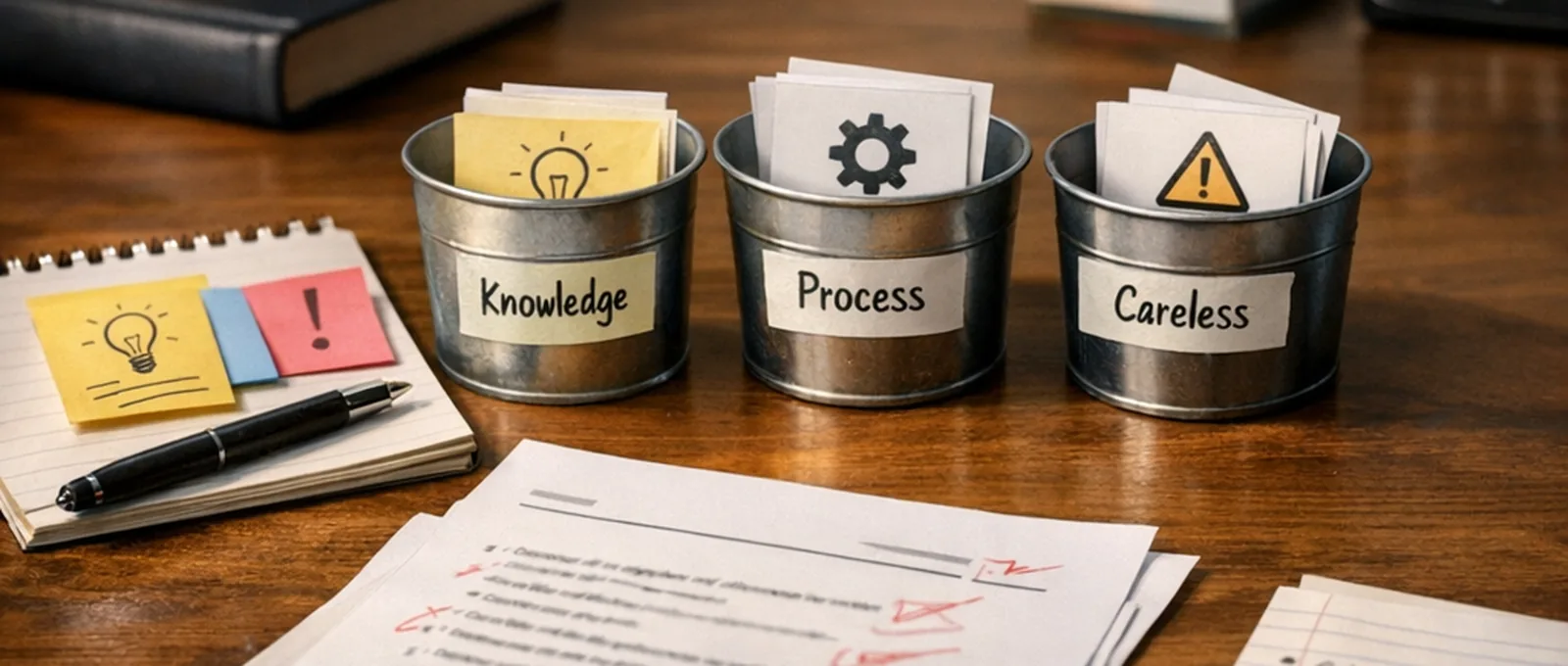
- A simple 3-bucket table: Knowledge / Process / Careless.
- Optional for the last 4 minutes: answer key, rubric, or teacher feedback.
The 14-minute retake workflow (do it today)
Yes, 14 minutes. Not 13. Not “until I feel better.” Tight time limits keep it doable, even on busy weeks.
- Set a timer. Make it a ritual.
- Don’t start by reading solutions. Start by trying.
Minute 0–2: Reset + pick your target
- Write: course + assessment name + date + next assessment date.
- Pick 3–5 questions/topics that cost you the most points (or felt shaky).
- Define the win: “I will not lose points for this same reason next time.”
Minute 2–8: Retake from memory (no notes)
- Redo the chosen questions, or reconstruct them as best you can.
- Don’t remember the exact question? Recreate the skill: same problem type, same steps.
- Mark confidence per item: High / Medium / Low.
- Circle where you got stuck: the exact step, not “the whole thing.”
If you begin by reading solutions, you’re studying the version of you who already knows the answer. Retaking forces you to study the version of you who shows up on test day.
Minute 8–12: Diagnose with the 3 buckets
- For each miss, choose one primary cause. Don’t stack excuses like pancakes.
- Write a one-line reason that’s specific enough to act on.
- Create a “trigger” you can notice next time (example: “When I see a negative exponent…”).
Minute 12–14: Build your 3-bucket fix list (tiny + schedulable)
- Write one fix action per bucket that takes 10–20 minutes.
- Schedule them: assign an exact day/time or attach to your next study session.
- Pick a next check: a 5-question mini-quiz, or one timed problem set.
The 3 buckets (with examples that don’t waste your time)
The label matters because it tells you what kind of practice actually fixes the problem.
Rule of thumb: one mistake = one bucket = one fix action.
Bucket 1: Knowledge gap (you didn’t know / couldn’t recall)
- Signals: blanking, wrong formula/definition, mixing concepts, guessing.
- Fix actions (pick one): 10-card micro-deck, one-page “minimum notes,” or 5 retrieval reps across 3 days.
- Example: You mis-remembered a biology process → fix: 5-minute brain dump, check the model, redo tomorrow.
Bucket 2: Process error (you knew it, but the steps broke)
- Signals: right concept, wrong method; skipped a constraint; algebra/logic drift; misapplied a rule.
- Fix actions: write a 5-step checklist; do 3 “slow perfect” reps; then 3 timed reps.
- Example: Stats hypothesis test: right test, wrong tail/conditions → fix: decision tree + 6 quick classifications.
Bucket 3: Careless slip (execution/attention, not understanding)
- Signals: sign error, copied wrong number, misread units, bubbled wrong, answered a different question than asked.
- Fix actions: 20-second final-check routine; add a “units/label” step; force one pause per problem.
- Example: Forgot to convert minutes to hours → fix: highlight units and do a 10-second “units scan” before submitting.
If you don’t get the test back (still works)
Not getting the paper back is annoying, but it doesn’t block improvement. You’re correcting patterns, not building a museum exhibit of your errors.
- Use memory, the syllabus topic list, and what you felt during the test to diagnose likely buckets.
- Perfect reconstruction isn’t required. Actionable pattern spotting is.
Fast substitute: the “3 prompts” reconstruction
- List 3 questions you remember struggling with (even vaguely).
- List 3 topics that surprised you or felt under-practiced.
- List 3 moments you rushed, panicked, or changed an answer.
Get data anyway (without being awkward)
- Ask your teacher/TA: “What were the top 3 missed concepts/processes?”
- Request one sample problem of each missed type to practice.
- If allowed, do corrections from the rubric or topic list.
Turn the fix list into next week’s study plan (without adding hours)
A fix list that isn’t scheduled is just a wish list wearing a trench coat.
- The fix list only works if it lands on your calendar.
- Aim for three short sessions, not one heroic, life-consuming one.
The “3×15” schedule (plug-and-play)
- Session A (15 min): Knowledge fix (micro-retrieval + 5 questions).
- Session B (15 min): Process fix (checklist + 3 slow perfect reps).
- Session C (15 min): Careless fix (timed set + final-check routine).
What to track in LogMyStudy (so you see progress)
- Log each fix action as its own task with a tag: #knowledge #process #careless.
- Write the trigger phrase you’re training (example: “When I see ‘rate,’ I write units first.”).
- After the next quiz, compare: did the same bucket show up again?
Common traps (and quick fixes)
- Don’t let this become a 2-hour guilt marathon.
- The point is behavior change, not punishment.
Trap: “Everything was careless”
- Reality check: “careless” often hides a missing process or checklist.
- Fix: name the failing step precisely. Where did it go wrong?
Trap: Fix actions that are too big
- If it takes >20 minutes, you won’t repeat it consistently.
- Fix: shrink it to a micro-action + one measurable rep (example: “5 questions timed”).
Trap: Only reviewing wrong answers
- You can repeat mistakes on “lucky correct” answers too.
- Fix: include 1–2 low-confidence correct answers in the retake.
FAQ
How often should I do the 14-minute retake method?
After every quiz/test you can access—even small ones. Consistency beats intensity: one 14-minute review per assessment compounds fast.
What if my test is mostly essays or short answers?
Retake by rebuilding outlines from memory, then compare to the rubric/model answer. Bucket the miss as Knowledge (missing content), Process (weak structure/argument), or Careless (ignored prompt/requirements).
Isn’t this basically test corrections?
Test corrections are the output. The retake method is the workflow: start with recall, diagnose the cause, and create a fix action that prevents the same loss next time.
How do I stop making careless mistakes on exams?
Treat “careless” as a system problem: add a 20-second final-check routine, standardize a checklist (units, sign, what’s being asked), and practice under light time pressure so the routine sticks.
What if I feel too discouraged to review right after getting the grade?
Take a short buffer (walk, snack), then do the 14 minutes anyway. The timer prevents spiraling and turns the grade into a concrete next step.
How many mistakes should I analyze?
Start with the 3–5 that cost the most points or represent a pattern. Depth on a few repeatable issues beats shallow notes on everything.